Contact lens catalogue
Standard 15-step vision exam


Assessing your medical history helps you understand the problem your eyes are having and receive dedicated advice from a specialist. This process takes about 5 minutes depending on each subject, measuring directly 1-1 with a technician in a private eye examination room helps customers feel more comfortable in sharing and answering questions. Dien Bien Phu Optical is very careful in assessing the eye health of patients. We do this by asking and analyzing the patient's medical history carefully at the first step of recording.

Visionix VX110 objective refraction device helps to accurately measure nearsightedness, farsightedness, and astigmatism of the eye objectively, regardless of the customer's subjective perception.
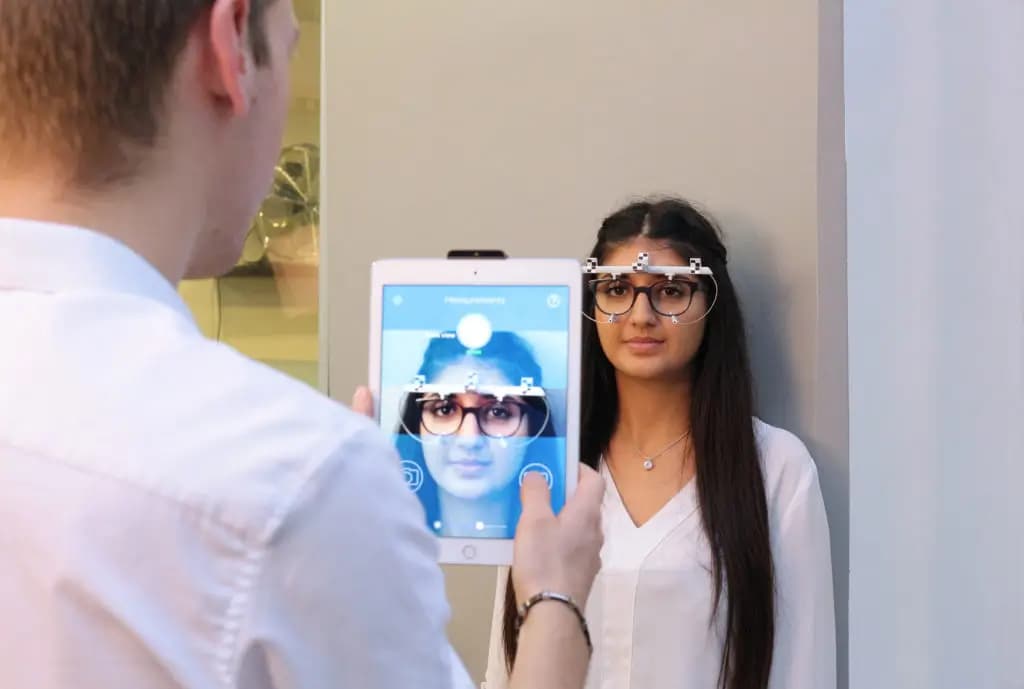
We imported data from the Visionix VX110 objective refractometer and the Nidek LM1800 pd lens meter into the Nidek RT6100. The pupillary distance (the distance between the centers of two people) must coincide with the center of the lens to ensure that the light passing through the retina is focused correctly, helping the image through the eye to be clear and sharp. Therefore, the pupillary measurement step is added to the important eye measurement steps to minimize the difficulty of adaptation (dizziness, tired eyes) when customers use new glasses.
For people with corrected vision, it will be 10/10 without glasses, but below 8/10 and there are the following signs that need to be checked in the next step. 1. Blurred vision: This is a sign that you should have your eyes checked immediately. This could signal a vision-related impairment. A common cause of blurred vision is a refractive error. 2. Squint to see better: People with vision problems always have to squint to see better. Images are scattered unevenly when entering the retina. At this time, you have to squint to reduce the area of the image entering, helping to focus on the right point of clear vision. 3. Difficulty seeing at night: It is a sign of many vision problems. When it gets dark, the light decreases and at the same time it causes difficulty in distinguishing the details of objects. 4. Eyes sensitive to light: It is a sign that you should get your eyes checked immediately. Whether it is free or paid, it is a warning that you should go get your eyes checked right away. It is saying: you are experiencing a sudden decrease or worse, loss of eye power.
To see if the myopia is progressing or if the old glasses are not suitable or if the lenses are scratched and damaged or if the glasses fitting technique is incorrect and if new glasses need to be replaced, the next step is the current degree.
After determining the eye degree, the most modern Nidek Phoropter RT6100 visual acuity mask helps to measure comprehensively including distance and near vision, accommodation ability, etc. The measurement results by Nidek Phoropter are an important basis to help specialists make an accurate diagnosis of vision status and provide appropriate treatment regimen. At Dien Bien Phu Optical, the technician will set up different lenses to find the standard vision center and the largest deviation between the two eyes, and at the same time set up important parameters to perform the next eye measurement steps.
Astigmatism is the second most common refractive error after nearsightedness. Astigmatism occurs when the cornea or lens is irregularly shaped, preventing light from focusing onto the retina. Measuring astigmatism requires high precision and experience of the technician. At Dien Bien Phu Optical, we use the Nidek RT6100 device to accurately measure astigmatism and astigmatism axis, ensuring the most accurate cutting of glasses.
Measure the optimal sphere of the left eye and then calculate the astigmatism correction and axis of astigmatism similar to the right eye.
Binocular vision equalization is the final important step in the eye exam. The goal is to ensure that both eyes are working in harmony, avoiding a situation where one eye is working more than the other. The technician will adjust the glasses to achieve the optimal balance, helping the wearer feel comfortable and have stable vision for a long time.
Visual acuity and sensation testing with old glasses. New glasses need to be adapted and optimized by measuring and taking note of the adaptation time with new glasses.
After determining the current degree, the customer will try on glasses with suitable lenses to check the actual distance vision. If dizziness or lightheadedness occurs, it will be optimized with the most stable vision. This is the final step of the nearsightedness measurement process, helping the specialist to comprehensively evaluate the results of the nearsightedness measurement.
Eyeruler-2 (Essilor): Modern and comprehensive measuring device, capable of giving complete results with all FIT parameters for single/multifocal lenses This device gives us specific parameters of the eye such as: - PD: Pupillary distance - FH: Distance from center of eye to lowest end of frame - Vertex: Distance from eye behind lens to retinal surface - Pantoscopic: Tilt angle - Wrap Angel: Horizontal tilt angle - DBL: Nose bridge distance - ELD: Distance from pupil to back of eye in glasses